
Indirect tax collections saw only a meagre 3.5 per cent growth, as mop-up from Customs fell sharply on account of a drop in imports.
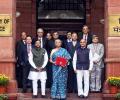
Finance Minister Nirmala Sitharaman on Thursday presented her sixth Budget in a row, equalling the record of former Prime Minister Morarji Desai.

Advance corporation tax collections grew 8 per cent in H1FY17 against 6 per cent last year. A moderate pick up in advance corporation tax collections suggest the sector might not witness significantly high growth in FY17, says Dilasha Seth.

The government wants new domestic companies to set up their manufacturing units fast and hence the concessional tax rate of 15 per cent has been extended by a year till March 2024, revenue secretary Tarun Bajaj said on Friday. Stating that direct and indirect tax collections are going up and have good buoyancy, Bajaj said it means that the corporate sector is also doing well, and India's tax to GDP ratio could be "highest ever" in the current year. The Budget 2022-23 presented on February 1 has proposed that the concessional 15 per cent corporate tax rate would be available for one more year till March 2024 for newly incorporated manufacturing units.


Revenue buoyancy of GST will be key to improve the resource position of both central and state governments.

Average monthly GST collection rose from Rs 90,000 crore during the first year of its implementation -- 2017-2018 -- to Rs 1.68 trillion during 2023-2024, representing an 87 per cent rise.

FM, in the revised estimates for 2012-13, projected a fiscal deficit of 5.2 per cent. This is now likely to be revised in light of better than expected revenue realisation and savings.

Chidambaram to meet revenue boards on how to get much more and quickly; special audits and notices among measures likely.

About 1.2 trillion tax evasion cases have been detected and as many as 59,000 entities identified for verification in order to ascertain whether they are fake.

Chief statistician T C A Anant says growth figure might go up once indirect tax data is fully in, however, he agrees that private expenditure is yet to pick up
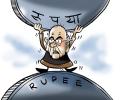
For the first eight months of the current financial year, the figure stood at Rs 7.17 trillion.
Petroleum Minister Jaipal Reddy said these measures would cost the government Rs 49,000 crore in the current financial year.

The collection from borrowings and other liabilities will be 20 paise, while income tax will yield 17 paise to every rupee collection.

Widening of the tax base, doing away with cess and surcharge, improvement in compliance and moderation in tax for emerging sectors are some of the suggestions submitted to the Finance Ministry ahead of the Budget by Think Change Forum (TCF). Experts are of the opinion that there is a need to grow tax revenues for the government to drive economic growth and make investments in developmental activities, TCF, the think tank said in a statement. Towards this end, poor compliance was identified as a weak link in achieving targeted collections leading to complex issues like overtaxing, complicated tax structures, rising litigation, among others.
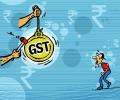
The broad trends of GST collections will make you wonder if indeed the biggest indirect tax reform in the country has led to a real improvement in revenues, notes A K Bhattacharya.

Corporation tax is the single largest source of income, contributing 21 paise to each rupee earned.

The 31st meeting of the Goods and Services Tax (GST) Council, held in December 2018, deferred a decision to reduce the GST rate for cement from 28 per cent to 18 per cent. This was despite recognising that cement - along with automobile parts - remained among the few mass-consumption items still taxed at the highest slab, which was originally meant for luxury and sin goods.

Because of the economic slowdown, the actual corporation tax collection in 2012-13 was at Rs 3,56,326 crore (Rs 3,563.26 billion), up 10.4 per cent year-on-year as against 15.6 per cent estimated in the Budget.

Exemptions, and the fact that farm income is outside the tax net, ensure that India's tax-GDP ratio stays low.

Instead of conceding the demand for a cut in personal income-tax rates, Finance Minister Nirmala Sitharaman should phase out many exemptions in both personal and corporation taxes, suggests A K Bhattacharya.

The government last fiscal missed its direct tax collection target, and for this financial year it has set a higher revenue mobilisation goal of Rs 13.80 lakh crore.

'We revolutionised the system in a manner so that the chances of leakage will be much lower than it was in the beginning.'
.jpg)
As of September, account for bulk of applications for availing of the government's amnesty scheme.

Increased income tax collection is going to be a major consequence of going cashless and this should promise a future of lower taxes and higher purchase power soon, says Anil Rego
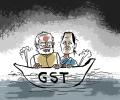
CAG recommended fixing a definite time frame for rolling out simplified GST return forms.

'The bull market cycle ran for five years. It's the end of that cycle.' 'The next cycle is a down cycle, and in that down cycle, you will see the Sensex falling from their highs of around 68,000 to maybe 40,000-50,000 at the bottom of the cycle.'

IT companies see this as a huge opportunity.

If the surge in tax collections is sustainable, the finance minister has the elbow room to shoot for a fiscal deficit
From road transport to health insurance, tax rules have changed from October 1.

'Vigilance' is a dreaded term for PSB employees and there are instances where this fear is misused by the higher authorities to tame their subordinate officials. This fear always deters PSB executives from making decisions -- the fewer the decisions, the less the chance of falling into trouble, points out Tamal Bandyopadhyay.

Finance Minister Nirmala Sitharaman will present her 8th straight Budget and all eyes will be on the much-expected tax relief for the middle class. Sitharaman had in her first Budget in 2019 replaced the leather briefcase -- which had been in use for decades for carrying Budget documents -- with a traditional 'bahi-khata' wrapped in red cloth.

With this, 85 officers, including 64 high ranking ones, have been compulsorily retired.

The key now is expenditure control, but how much?

Although the June collections were higher than that in July, however, it is important to note that during the previous month, a large number of taxpayers also paid taxes pertaining to February, March and April 2020 on account of the relief provided due to COVID-19.

If oil prices rise, the government would face an uncomfortable political decision.

Sources said the action was in line with Prime Minister Narendra Modi's address to the nation from the ramparts of Red Fort when he said some black sheep in the tax administration may have misused their powers and harassed taxpayers, either by targeting honest assesses or by taking excessive action for minor or procedural violations.
